


Negotiation ADR Support
WHAT WE PROVIDE
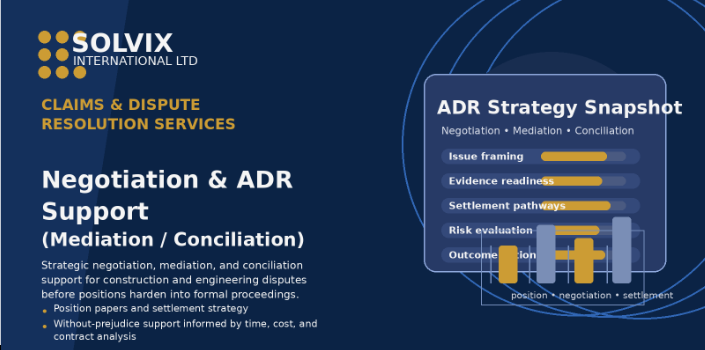
Negotiation & ADR support for construction and engineering disputes
Solvix International provides negotiation and alternative dispute resolution support for parties seeking to resolve construction and engineering disputes efficiently, commercially, and with a clear understanding of technical and contractual risk. We help clients frame issues, evaluate strengths and weaknesses, prepare settlement positions, support mediation or conciliation proceedings, and connect the commercial discussion to the evidence behind time, cost, liability, and entitlement.
- Support negotiations before disputes escalate into arbitration or litigation.
- Prepare mediation and conciliation positions grounded in contract, delay, disruption, and quantum analysis.
- Assist clients, counsel, and project teams with issue framing, rebuttal points, and settlement strategy.
SERVICE SCOPE
What this service covers
Negotiation strategy Structure negotiation positions, concessions, sequencing, and decision thresholds based on the facts and commercial objectives. | Mediation support Prepare position papers, issue summaries, briefing packs, and technical inputs for mediation sessions. |
Conciliation support Assist parties through less adversarial settlement processes where independent facilitation can help bridge technical disagreements. | Risk evaluation Test exposure, evidential weaknesses, procedural risk, and likely outcomes if the matter proceeds further. |
Settlement scenario analysis Compare commercial pathways, settlement ranges, cost of continuation, and strategic trade-offs. | Technical dispute support Integrate delay, quantum, contractual entitlement, and forensic issues into the ADR strategy where needed. |
How Solvix approaches negotiation, mediation, and conciliation support
Our approach is designed to improve clarity and negotiation discipline. We work from the underlying technical and contractual evidence, identify what will most influence the settlement dynamic, and help clients decide where to press, where to concede, and how to present a position that is both credible and commercially effective.
- Issue definition and objective setting: Confirm the issues in dispute, desired outcomes, non-negotiables, and internal decision constraints.
- Evidence and records review: Assess the contract, chronology, correspondence, programmes, notices, cost records, and expert or consultant inputs already available.
- Strengths, weaknesses, and exposure analysis: Identify the key strengths of the client position, counterpart arguments, procedural vulnerabilities, and downstream dispute risk.
- Settlement strategy development: Develop talking points, issue matrices, negotiation pathways, concession boundaries, and alternative scenarios.
- ADR session support: Provide live or pre-session support for mediation or conciliation, including technical clarification and rebuttal assistance.
- Outcome documentation and next-step planning: Record agreed principles, unresolved issues, and the recommended route if full settlement is not achieved.
Practical point
Solvix can support standalone settlement discussions or work alongside legal teams, experts, and project controls specialists where the dispute demands integrated technical input.
Common matters we support
- Negotiation support following submission of a time or cost claim.
- Mediation preparation after claim and response positions have hardened.
- Conciliation support where parties want a structured but less adversarial route to settlement.
- Commercial strategy reviews where the cost of continuing the dispute needs to be measured against realistic settlement outcomes.
- Issue framing and evidential support for disputes involving variations, delay, disruption, payment, termination, defects, or final account matters.
- Executive decision support for clients who need an independent view before making or accepting an offer.
NEGOTIATION & ADR SUPPORT METHODOLOGY : A practical process for turning technical evidence into a commercially defensible settlement strategy
→ Clarify the issues, relief sought, counterparty positions, and current decision point.
→ Assess the contract, chronology, notices, delay records, cost data, and key correspondence.
→ Identify strengths, weaknesses, settlement pressure points, and litigation or arbitration exposure.
→ Prepare issue matrices, without-prejudice positions, talking points, and concession boundaries.
→ Assist during mediation or conciliation with analysis, rebuttal support, and live scenario testing.
→ Record terms, unresolved matters, and next-step strategy if settlement is partial or unsuccessful.
Can be instructed as standalone settlement support or integrated with claims, delay, quantum, expert, or legal workstreams.
What we typically review and deliver
Effective ADR support depends on having the right information in the room. We work with the records available, identify evidential gaps that may affect leverage, and focus the discussion on the issues that matter most to settlement. Our deliverables are designed to be practical, concise, and decision-oriented.
Typical records reviewed • Executed contract, amendments, instructions, and relevant clauses • Claims, responses, notices, and reservation-of-rights correspondence • Programmes, delay analyses, or progress records where time issues matter • Cost records, valuations, payment data, and quantum support • Meeting minutes, emails, expert inputs, and prior negotiation notes • Mediator or conciliator briefing requirements where applicable | Typical deliverables • Negotiation briefing note or settlement strategy memorandum • Issue matrix summarising strengths, weaknesses, and pressure points • Position paper or mediation support pack • Settlement scenario analysis and decision-support commentary • Rebuttal notes for counterpart submissions or live discussions • Post-session action note and next-step recommendations |
USE CASES
Where this service adds value
Before formal proceedings Use negotiation or mediation support early to narrow issues, manage exposure, and avoid unnecessary escalation. | After claims have been exchanged Clarify what is genuinely disputed, what can be agreed, and how each issue affects settlement leverage. |
Alongside legal and expert teams Translate technical findings into negotiation-ready positions while keeping the commercial objective in view. | For executive decision-making Provide management with a balanced view of risk, settlement options, and the likely consequences of continuing the dispute. |
Frequently asked questions
What is ADR in construction disputes?
ADR means alternative dispute resolution and commonly includes negotiation, mediation, and conciliation used to resolve disputes without immediately proceeding to arbitration or litigation.
Do you attend mediation or conciliation sessions?
Support can be provided before, during, or after sessions depending on the client need, jurisdiction, and role required.
Can this service be combined with delay, quantum, or contractual review?
Yes. Solvix can integrate settlement support with technical analyses so the negotiation position is backed by robust evidence.
Why clients use Solvix for negotiation and ADR support
We connect commercial negotiations to the technical realities of time, cost, contractual entitlement, and evidence.
- Our outputs are structured for decision-making, helping clients see not only the strength of the case but also the cost and risk of continuing the fight.
• We can support direct negotiations, mediation, and conciliation as part of a wider claims and dispute resolution strategy.