


EOT Assessment
WHAT WE PROVIDE
Solvix International provides extension of time assessment services for employers, contractors, subcontractors, developers, project managers, funders, insurers, and legal teams who need an independent view on time entitlement.
We turn contract clauses, programme data, contemporaneous records, delay events, and project chronology into a clear opinion on whether additional time is due and, if so, for how long.
- Assess excusable, compensable, and non-excusable delay events by reference to the contract, project facts, and schedule effect.
- Review notices, instructions, approvals, access constraints, design release dates, and site records to determine whether procedural and substantive requirements have been met.
- Support claim preparation, claim defence, independent determination, adjudication, mediation, arbitration, and litigation with clear, decision-ready outputs.
SERVICE SCOPE
What this service covers
An extension of time assessment is a coordinated review of contractual entitlement, delay causation, programme criticality, contemporaneous records, notice compliance, and mitigation. Solvix approaches EOT matters with both a project-controls lens and a disputes lens so the analysis is commercially practical and technically robust.
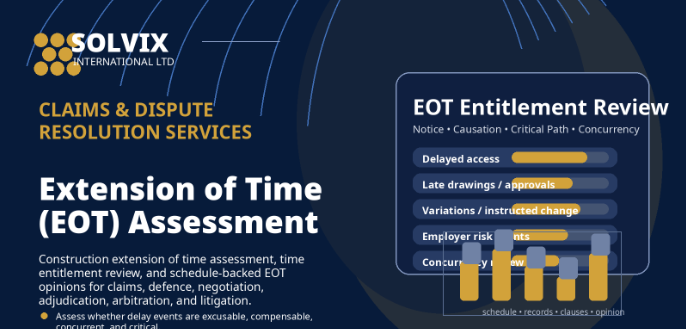
Delayed access or possession Review late handover, restricted access, and unavailable interfaces against the planned sequence and milestones. | Late drawings, approvals, or information Assess delayed design releases, approvals, responses, or employer-supplied information against critical activities. |
Variations and instructed change Examine instructed scope change, redesign, and resequencing to determine whether extra time is justified. | Employer-risk events Assess suspension, instruction delay, utilities, third-party constraints, and authority approvals. |
Concurrency and overlapping causes Test overlapping employer-risk and contractor-risk events, including true concurrency and pacing arguments. | Mitigation and acceleration Review recovery steps, revised sequence, additional resources, and whether mitigation or acceleration was reasonable. |
Who typically instructs this service
Employers and contract administrators assessing an extension request; contractors and subcontractors preparing or defending EOT submissions; and legal teams seeking an independent time opinion before settlement discussions or formal proceedings.
Typical EOT questions we assess
- Was the event covered by the contract as a relevant event, relevant matter, compensation event, or equivalent entitlement trigger?
- Did the claiming party comply with notice provisions, particulars requirements, and update obligations, or is there a time-bar issue to address?
- Did the event affect the critical path or a milestone that actually controlled completion at the relevant time?
- What part of the claimed delay is attributable to employer risk, contractor risk, neutral events, or concurrent causes?
- Was the mitigation response reasonable, and were alternative work fronts or resequencing genuinely available?
- What period of extension, if any, is supportable on the records and methodology used?
EOT ASSESSMENT METHODOLOGY
A structured process for establishing time entitlement and evaluating excusable delay
→ Review extension-of-time clauses, notice rules, completion milestones, conditions precedent, and administrator powers.
→ Confirm the accepted programme, status date, actual progress, and update logic relevant to the assessment.
→ Compile and evidence from notices, instructions, RFIs, design releases, access records, weather logs, and approvals.
→ Test whether the event affected the critical path or a key milestone and whether the claimed period is supported.
→ Assess overlapping causes, contractor risk, mitigation steps, pacing arguments, and acceleration measures.
→ Issue an independent EOT opinion, chronology, event analysis, and recommendations for claim strategy or determination.
How we assess EOT entitlement
Our methodology is built to withstand scrutiny from project stakeholders, contract administrators, expert teams, and dispute forums. The precise approach varies by contract form, available records, and programme status, but the core logic remains consistent: establish the contractual basis, identify the event, test schedule effect, consider concurrency and mitigation, and issue a reasoned opinion.
- Contract review and entitlement mapping: Identify extension of time provisions, notice mechanisms, compensation links, and contractual tests.
- Programme and milestone review: Review the accepted baseline, updates, progress snapshots, and milestone logic relevant to the event.
- Event chronology and evidence collation: Align notices, instructions, approvals, minutes, and correspondence into a factual timeline.
- Critical path and causation testing: Test whether the event affected completion directly and whether float or alternate sequence changed the outcome.
- Concurrency, pacing, and mitigation review: Consider overlapping causes, pacing arguments, mitigation steps, and acceleration measures.
- Opinion drafting and strategic recommendations: Issue an independent conclusion on entitlement and highlight strengths, weaknesses, and key risk points.
Methodology note
Depending on the records and dispute profile, Solvix can support high-level contractual EOT reviews, event-based schedule assessments, or more detailed critical path and time impact studies.
RECORDS AND OUTPUTS
Records typically reviewed
Strong EOT opinions depend on the quality of project records. We work with the available record set while also identifying evidential gaps, conflicting narratives, and procedural weaknesses so clients understand both the strength of the time case and the vulnerabilities that may be challenged
Typical records reviewed • Contract conditions, amendments, and notice provisions • Accepted baseline programme and subsequent updates • Progress reports, look-ahead schedules, and milestone trackers • Instructions, variation orders, and design issue registers • Approval logs, RFIs, meeting minutes, and site records • Access records, handover logs, utility and authority interfaces | Typical deliverables • Independent extension of time opinion or assessment memorandum • Delay event register and entitlement matrix • Chronology of notices, instructions, and key project events • Findings on criticality, concurrency, mitigation, and supportable period • Executive summary for negotiation, determination, ADR, or legal teams • Inputs for broader delay analysis, claims preparation, or expert reports |
Frequently asked questions
What is an extension of time assessment in construction?
An extension of time assessment is an independent review of whether project delay events entitle a contractor or subcontractor to additional time under the contract. It considers the contract wording, notices, project records, programme effect, critical path, concurrency, and mitigation.
When should an employer or contractor instruct an EOT assessment?
An EOT assessment is useful when an extension request is being prepared, reviewed, defended, negotiated, or determined, or when delay issues may later develop into adjudication, arbitration, or litigation.
Does an EOT assessment always require a full forensic delay analysis?
Not always. Some matters can be assessed through a focused contractual and programme review. More complex disputes with contested causation or multiple overlapping events may require deeper delay analysis.
What records are most important for an EOT claim assessment?
Key records usually include the contract, accepted programme, programme updates, notices, instructions, progress reports, design release information, approval logs, meeting minutes, site records, and delay-event correspondence.
Can Solvix support both EOT claims and EOT claim defence?
Yes. The same structured methodology can be applied to prepare a claim, evaluate a submitted claim, respond to an opposing position, or advise on the strength of the time case before formal proceedings.
How does EOT assessment relate to delay analysis and disruption analysis?
EOT assessment focuses on time entitlement under the contract. Delay analysis may provide a deeper programme-based view of causation and critical path effect, while disruption analysis addresses productivity loss and inefficiency rather than only completion delay.
Why clients use Solvix on EOT matters
- We combine contractual interpretation, programme awareness, and dispute-focused writing so the analysis is practical for project teams and legal stakeholders alike.
- We can support a matter from early internal review through without-prejudice negotiation, determination, ADR, arbitration, and litigation support.
- Our work is designed to communicate clearly: what happened, what the contract says, what the records show, where completion was controlled, and what time outcome is supportable.