


Quantum Analysis
WHAT WE PROVIDE
Solvix International provides quantum analysis services for employers, contractors, subcontractors, developers, funders, project managers, commercial teams, and legal advisers who need a robust financial assessment of a construction or engineering claim.
Our work focuses on translating project events, records, and contractual positions into a clear commercial valuation so decision-makers understand what is recoverable, what is overstated, and what evidence is required to support or challenge the claim.
- Assess prolongation, disruption, variation, acceleration, termination, defects, and other loss-and-expense heads of claim using a method appropriate to the records and contract position.
- Trace claimed sums back to project facts, cost ledgers, procurement records, labour and plant data, subcontract accounts, and contemporaneous instructions so the valuation is evidence-led rather than theoretical.
- Align quantum findings with delay analysis, entitlement review, and dispute strategy so time, causation, liability, and cost positions work together rather than in isolation.
CORE QUANTUM ISSUES WE ASSESS
Where quantum analysis is applied
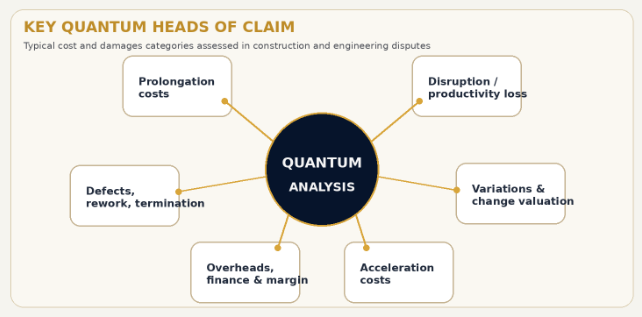
Quantum analysis is not limited to one type of claim. Depending on the project circumstances, we assess direct cost, time-related cost, indirect cost, overhead recovery, and associated commercial consequences arising from instructed change, delay, disruption, inefficiency, suspension, acceleration, termination, or remedial works.
Prolongation costs Assessment of site overheads, supervision, preliminaries, extended plant, staff, temporary facilities, insurances, and other time-related cost associated with excusable or compensable delay events. | Disruption and productivity loss Evaluation of labour and resource inefficiency, reduced output, trade stacking, resequencing, fragmentation, and cumulative impact where the project events affected the cost of performing the work. |
Variations and change valuation Review of instructed and disputed variations, scope growth, remeasurement issues, build-up pricing, quotations, dayworks, and the reasonableness of applied rates and mark-ups. | Acceleration costs Assessment of overtime, additional shifts, supplementary crews, premium plant usage, resequencing measures, and other mitigation or acceleration expenditure incurred to protect milestones or completion. |
Overheads, finance, and margin Review of head office overhead contribution, financing cost, profit or margin considerations, and the basis on which indirect cost recovery is claimed, resisted, or apportioned. | Defects, rework, and termination Commercial review of remedial works, replacement cost, back-charges, completion cost following termination, and other downstream cost consequences where responsibility and recoverability are disputed. |
Who typically instructs this service
Employers and developers needing an independent commercial view; contractors and subcontractors preparing or defending claims; contract administrators assessing entitlement and valuation; insurers, funders, and legal teams needing a defensible damages position before negotiation or formal proceedings.
How we perform quantum analysis
The strength of a quantum opinion depends on method, evidence, and consistency. Our approach is designed to test what the contract permits, what the records actually show, and how the valuation should be presented so it can withstand commercial scrutiny.
- Scope the commercial issue
We begin by defining the claim heads, relevant contract mechanisms, the period or work packages affected, and the precise question to be answered. This prevents the analysis from drifting into a broad cost review when the real issue may be a focused entitlement and valuation dispute.
- Test records and causation
We review contemporaneous records to understand whether claimed cost consequences can genuinely be linked to the events alleged. This includes instructions, notices, schedules, progress records, procurement data, time sheets, payroll, plant logs, subcontract accounts, invoices, ledgers, and payment records.
- Build the valuation model
We select a calculation basis suited to the evidence and contract context. Depending on the issue, this may involve direct cost build-up, measured or actual cost review, rate analysis, allocation testing, time-related cost modelling, or comparison against budgets, tenders, or unaffected performance.
- Reconcile, challenge, and verify
We test reasonableness, avoid duplication, challenge unsupported uplifts, and reconcile the figures across source documents. Particular attention is given to mitigation, overlap between claim heads, entitlement assumptions, and whether the claim seeks recovery of items that are already absorbed elsewhere.
- Report and support strategy
The final step is to present the quantum position in a way that is technically sound and commercially useful. We prepare reports, schedules of quantum, explanatory narratives, sensitivity testing, and rebuttal points that can be used in submissions, assessments, negotiation, ADR, arbitration, or litigation support.
Records and evidence we commonly analyse
Commercial and contract records | Contract conditions, amendments, BOQs, rates, variation quotations, correspondence, notices, payment certificates, cost reports, applications, and assessments. |
Project execution records | Baseline and update programmes, progress reports, site diaries, instructions, RFIs, design releases, method statements, productivity records, daily allocation sheets, and meeting minutes. |
Cost support records | General ledger extracts, cost codes, invoices, payroll, plant logs, hire records, material purchase orders, delivery notes, subcontract accounts, and internal allocation schedules. |
Claim and dispute records | Claim submissions, rebuttals, expert materials, settlement positions, adjudication or arbitration pleadings, and any prior determinations that shape the valuation framework. |
Our methodology is designed to create clarity, discipline, and traceability. The exact scope depends on the forum, procedural stage, and nature of the dispute, but the core process remains consistent: understand the case, organise the record, perform the necessary technical or commercial analysis, and deliver outputs that are usable by the wider dispute team.
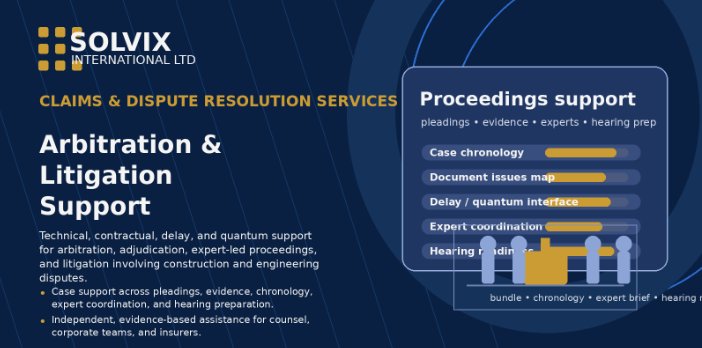
ARBITRATION & LITIGATION SUPPORT WORKFLOW
A structured path from dispute scoping to hearing-ready technical and commercial support
→ Review the dispute background, pleaded issues, procedural posture, and the support required from Solvix.
→ Organise key project documents, correspondence, notices, programmes, and valuation records into a defensible chronology.
→ Undertake contractual, delay, disruption, EOT, quantum, or forensic review aligned to the dispute questions.
.
→ Assist with issue lists, document schedules, assumptions, instructions, and analysis interfaces for legal teams and experts.
→ Provide memoranda, expert-briefing inputs, review comments, and analysis that can be tested in proceedings.
→ Support bundle refinement, chronology updates, cross-reference checks, demonstratives, and hearing-readiness reviews.
Typical outputs include issue matrices, chronology packs, review memoranda, expert-briefing inputs, rebuttal support, and hearing
Where this service adds value
Quantum analysis is most valuable when a project team needs clarity before positions harden, but it is equally effective when a dispute is already underway and the cost case must be tested rigorously.
- Claim preparation: Build a credible, evidence-supported valuation before submitting a prolongation, loss and expense, disruption, variation, acceleration, or damages claim.
- Claim defence and evaluation: Test whether an incoming claim is adequately evidenced, methodologically sound, contractually recoverable, and free from duplication or unsupported assumptions.
- Negotiation and ADR: Use a clear, well-structured quantum position to support without-prejudice negotiations, mediation, conciliation, or executive settlement discussions.
- Formal dispute support: Prepare quantum reports and schedules suitable for adjudication, arbitration, litigation support, or integration with independent expert and legal workstreams.
- Project recovery and commercial governance: Identify cost leakage early, clarify the commercial impact of live events, and support better decision-making before the dispute exposure escalates.
Typical outputs
• Quantum review reports and schedules of claim value. • Support schedules for prolongation, disruption, variation, acceleration, and damages heads of claim. • Rebuttal commentary, defence points, and challenge matrices for incoming claims. • Executive summaries for senior stakeholders and decision-makers. • Input to mediation statements, arbitration submissions, litigation support, and expert reports where required.
Frequently asked questions
What is quantum analysis in a construction claim?
Quantum analysis is the financial and commercial assessment of the sums said to arise from project events. It addresses how much is being claimed, how that figure is derived, whether the valuation is supportable, and whether the claimed items are properly linked to entitlement and causation.
How is quantum analysis different from delay analysis?
Delay analysis focuses on time and programme effect, such as impact on completion, milestones, and the critical path. Quantum analysis focuses on cost and damages, such as prolongation, loss and expense, disruption cost, change valuation, overhead recovery, and related commercial consequences. The two disciplines often need to work together.
Can you help even if the claim is only partly documented?
Yes. Part of our role is to assess whether the available evidence is sufficient for a reliable valuation and to identify what additional support would materially improve the position. Where records are limited, we make the evidential gaps visible so the client understands the strength and limits of the claim or defence.
Do you work for claimants and respondents?
Yes. We support affirmative claim preparation as well as claim defence and evaluation. The underlying discipline is the same: identify the facts, test recoverability, challenge unsupported assumptions, and present a balanced valuation that can withstand scrutiny.
Can this service support arbitration or litigation?
Yes. Quantum analysis can feed directly into negotiation, mediation, adjudication, arbitration, and litigation support. Where required, the work can also be aligned with wider dispute strategy and independent expert processes.
Why clients use Solvix for quantum analysis
- Commercial clarity: we focus on outputs that are understandable to project leaders, commercial managers, lawyers, and tribunal audiences.
- Integrated thinking: quantum analysis is coordinated with delay, entitlement, and claims strategy rather than treated as a stand-alone spreadsheet exercise.
- Evidence discipline: figures are traced back to records, assumptions are stated clearly, and weak areas are identified rather than hidden.
• Dispute readiness: the work can be used for internal decision-making, external negotiation, or escalation into formal proceedings.