



































- June 24, 2026
- Uncategorized
Introduction
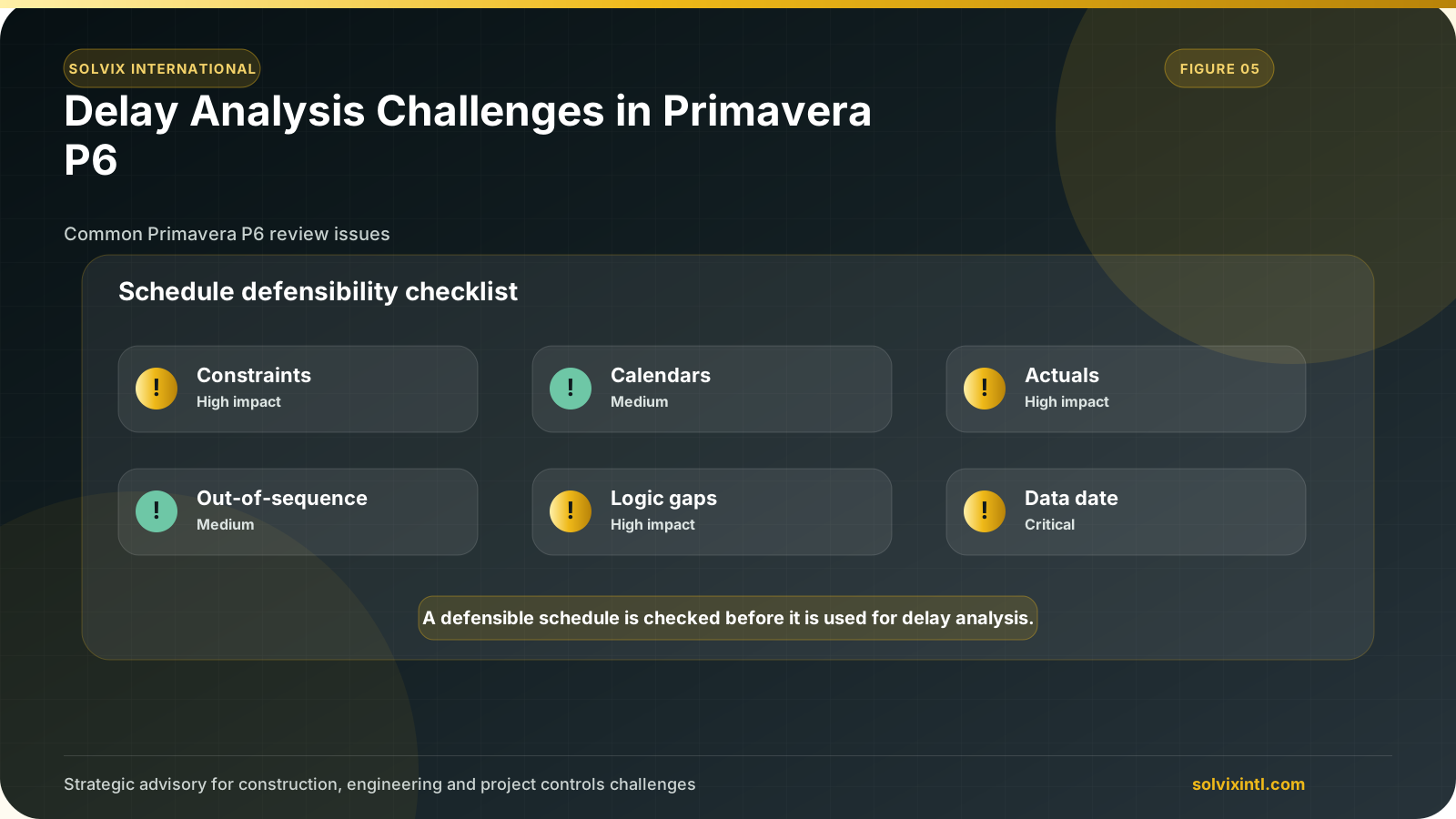
However, when it comes to delay analysis, Primavera P6 presents unique challenges. This article explores the complexities of delay analysis in Primavera P6, focusing on constraints, multiple calendars, actual date manipulation, out-of-sequence activities, dangling activities and negative float. It provides valuable insights for professionals analyzing delay claims using Primavera P6. It is important to note that while Primavera P6 excels in project time and cost management, its primary focus is not specifically tailored towards measuring and assigning responsibility for delays and accelerations. The following sections will explore the challenges that P6 users may encounter when using Primavera for assessing claims and conducting delay analysis.
Challenges of Delay Analysis in Primavera P6
| Working with Constraints in P6
constraints is essential in delay analysis to avoid unforeseen outcomes. It is important to distinguish contractual constraints, which are directly tied to contractual obligations, from other constraints. Analysts should be aware of whether constraints are contractually mandated or implemented solely to influence the analysis results. While it is a common practice to utilize constraints to consume float and designate specific activities as critical, it is crucial to approach this practice with care. Neglecting to properly consider constraints can introduce significant risks to the integrity and precision of delay analysis.
| Working with Multiple Calendars in P6
In the latest versions of Primavera, the ability to assign different calendars to each activity enables the creation of more realistic schedules. However, it is important to note that utilizing different calendars can sometimes result in inaccurate delay analysis outcomes. T Often, these periods are contractually classified as Excusable Non-compensable delays, for which neither the owner nor the contractor should be held accountable. Consequently, the decoupling of responsibilities from the calendar allows for potential manipulation within Primavera P6.
Manipulating a schedule to designate noncritical activities as critical during delay events is commonly referred to as “Spring-Loaded.”
To identify such manipulations, we Solvix recommend four checkpoints methodology:
Are activity durations consistently multiples of 5-day or 7-day weeks? This suggests a lack of effort in accurately estimating activity durations.
Does the percentage of critical activities to noncritical activities exceed 10%?
Are constraints deliberately manipulated to force noncritical activities into the critical path?
Is the average float per activity unusually high compared to typical scenarios?
| Actual Date Manipulation in P6
When updating a Primavera P6 schedule, it is crucial to convert the early and late dates to actual dates for accurate documentation of as-built data. However, incorrect assignment of actual start or finish dates can lead to unexpected delay analysis results. It is worth noting that manipulating the schedule by altering actual dates is recognized tactic in delaying claims. Additionally, incorporating delay types within Primavera P6 alongside actual data can be a valuable solution. Unfortunately, current versions of Primavera P6 do not provide identification of delay and acceleration types (such as Excusable/Compensable delay and Owner/Contractor’s Acceleration) for each activity’s duration. Consequently, P6 users who neglect to consider delay and acceleration types in activity durations, as well as disregard non-working periods specified in the calendar, may face challenges in accurately analyzing delay claims.
| Out of Sequence Activities
Consequently, the successor activity commences “out of sequence.” The current versions of Primavera address this situation by implementing one of two methodologies: “Retained logic” or “Progress override.” These approaches handle schedule updates differently. “Retained logic” maintains the original sequence logic, enabling the activity to start early while still adhering to the predetermined sequence for completion. In this case, the activity cannot reach completion until all its predecessors have finished. On the other hand, “Progress override” treats the out-of-sequence activity as if it has no predecessors, allowing it to continue without being affected by its unfinished predecessors.
| DANGLING ACTIVITIES in P6
A “dangling” activity is an activity that is not tied to any successor activities ( activities). Primavera marks the status of these activities as critical because they are independent of the rest of the activities on the schedule.
However, it is important to note that assuming a delay on a dangling activity will directly result in a project delay is not a realistic approach. This association enables the calculation of total float for dangling activities. Sometimes, an activity that is linked to both a start and finish date can unexpectedly become a “dangling” activity, often without the scheduler’s awareness. Such situations arise when Start-to-Start and Finish-to-Finish relationships are utilized. These dangling activities have adverse implications for delay analysis since they are disconnected from their float path, and their criticalities are challenging to ascertain. To mitigate these issues, we at Solvix recommend utilizing the Finish-to-Start relationship to avoid such problems.
| NEGATIVE FLOAT in P6
Within P6 scheduling, the concept of float typically represents a value of zero or a positive number. The presence of negative float in delay analysis prompts Primavera P6 to interpret it as an indication of criticality. Nevertheless, there are instances where negative floats may inadequately identify critical activities. To determine the critical path, two approaches are commonly employed. The first approach relies on the total float value, considering it zero or negative. The second approach focuses on identifying the longest path.
Need support with this topic?
Solvix provides
delay analysis and Primavera P6
schedule review services
Solvix International provides delay analysis and Primavera P6 schedule review services for contractors, employers, consultants, and legal teams. Our team supports delay analysis, claims preparation, quantum assessment, schedule evidence, and clear reporting for negotiation, adjudication, arbitration, or project recovery.

ramez.megahed.sci@gmail.com
Head of Architecture & DesignHead of Architecture & Design with over a decade of experience leading large-scale real estate and construction projects. Known for his strategic mindset and leadership excellence, he has successfully driven high-value developments from concept to completion while ensuring operational efficiency and long-term growth.